



 Solving environmental problems from the bottom-up and creating a sustainable society requires scientific knowledge that the local stakeholders can then use in their local environmental conservation and sustainable development and the appropriate social system. However, the scientific knowledge that scientists produce every day does not necessarily correspond to indigenous knowledge and how things get decided within local communities.
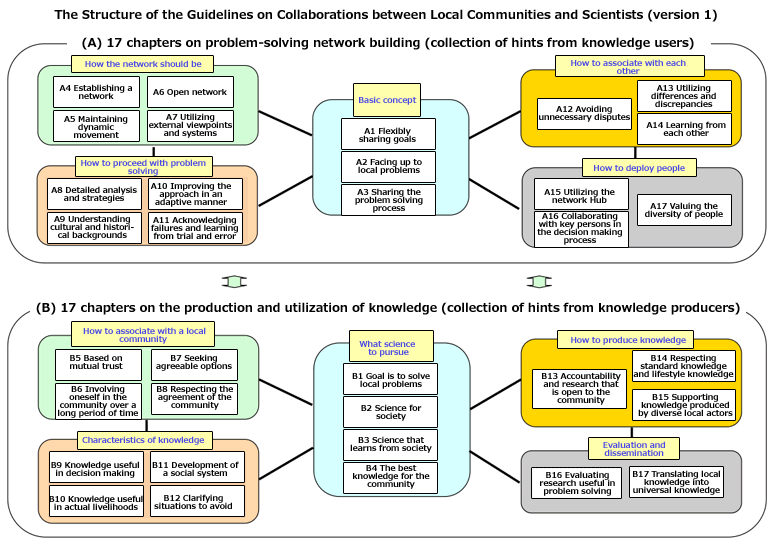
The local stakeholders and scientists who constitute LSNES have presented a variety of know-how for use in solving the problems local communities face, with their efforts having been integrated as guidelines on collaborations. The guidelines provide hints and guidelines producing and utilizing the diverse knowledge that is necessary in solving local problems and are intended for use as a reminder when local stakeholders and scientists work on problems together, and for evaluating each other’s situation as they proceed with solving problems.
The guidelines consist of “(A) 17 chapters on problem-solving network building” and “(B) 17 chapters on the production and utilization of knowledge” in thereby facilitating better collaborations taking place between scientists and stakeholders. (A) is for use by stakeholders working on solving problems who can then utilize the knowledge included and which provides them with guidelines that can be used in the field, while (B) is for knowledge producers working on producing knowledge that would be useful in solving local problems and which provides them with how to pursue a new science that evolves from learning from a community. The distinction between the two is rather vague and both (A) and (B) are actually closely related.
The process of creating the guidelines on collaborations is still ongoing and will continue. We therefore request your comments on possible improvements that are based on your own experience in thereby making the guidelines on collaborations more mature and that ensure sustainable development.