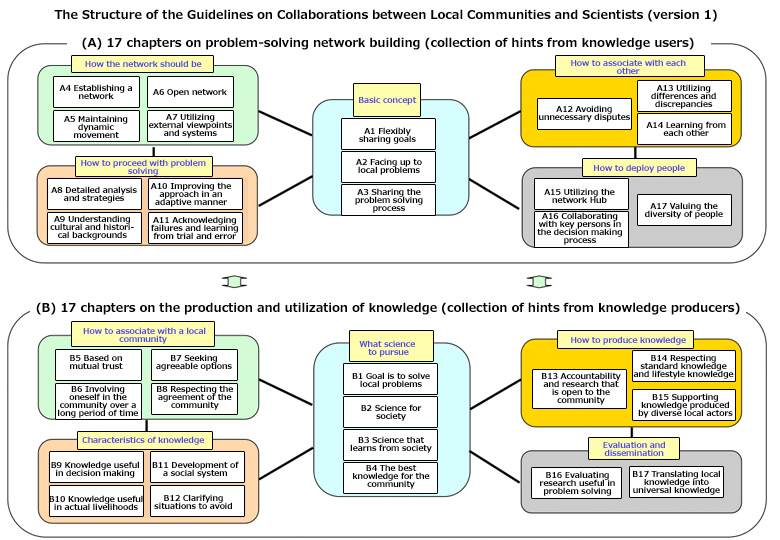
(A) 17 Chapters on Problem-Solving Network Building
Basic concept
| A1. |
Sharing the philosophy and goal of local activities in a flexible manner.
We will strive to promote collaborations between people with diverse values and ideals based on mutual trust by identifying a philosophy and goals that can be shared by the various actors and creating a flexible network. |
| A2. |
Sincerely dealing with the situation and problems the local community faces.
We will analyze the local environment, situation, and the problems the local community faces from various angles and then work on problem solving based on the analysis. |
| A3. |
Implementing problem-solving process with diverse people.
Our goal is for the various local stakeholder, scientists, and specialists to discuss local environmental problems and implement the process in collaboration, thus achieving problem solving efforts that are open to public. |
How the network should be
| A4. |
Establishing a network of people to support local problem-solving activities.
We will establish and operate a network of diverse stakeholders with various interests in thereby supporting and encouraging efforts to solve local problems. |
| A5. |
Maintaining dynamic movement of the network and avoiding inflexibility.
We will maintain dynamic movement of the network and avoid any inflexibility. We will continue to pursue the ideal dynamic network in thereby ensuring that the network of people working on solving local problems can continue to move ahead by changing its structure and functions in a flexible manner. |
| A6. |
Welcoming new actors and creating an open network.
We will welcome all new actors to the local network. We will create an open and active network that many people can participate in by changing each actor’s role flexibly.
|
| A7. |
Incorporating and utilizing external viewpoints and systems.
We will translate the viewpoints of outsiders and foreign systems concerning local environments, and then incorporate them according to the situation of local communities in thereby identifying the best options. |
How to proceed with problem solving
| A8. |
Implementing careful and detailed strategies.
As we are surrounded by diverse interests and values we will conduct detailed analysis of and solve problems by strategically incorporating the viewpoints of various people. |
| A9. |
Understanding and utilizing cultural and historical backgrounds.
We will attempt to understand the cultural and historical background of the local community and promote the understanding and participation of the diverse stakeholders. |
| A10. |
Improving the approach in an adaptive manner.
We will respond to complex and dynamically changing local environments, review the definitions and goals of the problems to be solved, and introduce new approaches in a flexible manner in thereby improving the approaches in an adaptive manner.
|
| A11. |
Acknowledging failures and learning from trial and error.
We will acknowledge the result of our problem solving efforts, not ignore any failure, and improve our efforts through trial and error. |
How to associate with each other
| A12. |
Avoiding unnecessary disputes and seeking understanding and consensus.
We will avoid any unproductive conflicts between people of different values or opinions and facilitate mutual understanding by carefully providing explanations and in thereby promoting activities that are based on mutual trust. |
| A13. |
Respecting each other’s differences and seeking how to utilize differences and discrepancies in local communities.
We consider it natural that local communities would include people of diverse characteristics and different problem awareness. We will seek out common values or common ground in acknowledging those differences. Rather than attempting to resolve the diversification of opinions and values we will attempt to identify new needs and human resources by accepting and utilizing any differences and discrepancies.
|
| A14. |
Maintaining an attitude of learning from each other and fostering the young generation.
Both the scientists and stakeholders will maintain an attitude of learning from each other, undergoing change and deepening mutual understanding and relationships, and foster the new generation that will bear the future through mutual learning.
|
How to deploy people
| A15. |
Making an arrangement that enables capable people to act as a network hub.
We will prepare an environment with a network hub that connects people of various positions and a catalyst that will promote collaborations through mutual learning and care. We will facilitate effective problem-solving processes.
|
| A16. |
Collaborating with key actors in the decision-making process.
We will fully understand the decision-making process of the local community and closely collaborate with the people and organization playing the central role in the decision-making process in thereby promoting concrete and workable measures.
|
| A17. |
Utilizing the diversity of human resources and local technologies.
We have the high expectation of identifying human resources with various special skills and knowledge such as in evaluating and extracting the problems of local environments, scientific knowledge that is useful in problem solving, the paperwork involved, understanding of legal systems, dissemination of information, fund raising, etc. We will facilitate everyone using their abilities to the fullest extent possible.
|
(B) 17 Chapters on the Production and Utilization of Knowledge
What science to pursue
| B1. |
The goal of research is to solve local environmental problems.
We will nurture science that produces knowledge which local communities can then use to solve the problems they face. We will pursue science that supports the local stakeholders who play the key role in problem solving in thereby utilizing the variety of knowledge needed to solve local environmental problems.
|
| B2. |
Science for society is the mission.
For knowledge produced as the results of research to be utilized by local stakeholders we will pursue “science in society and science for the society”, which isn’t complete itself within science. We will polish our technique of “translating” scientific knowledge according to the situation of the local community, and aim to produce knowledge that is useful in problem solving and which is in harmony with the indigenous knowledge and decision-making system of the community.
|
| B3. |
Learning from the local community and reviewing the role of science.
We have learned a variety of things from exchanges with local stakeholders. We will continue to learn from the field and improve our knowledge technology. Using that experience we will then continue to improve the quality of scientific research and review the science system itself.
|
| B4. |
Producing the best scientific knowledge for the local community.
In addition to pursuing universal scientific accomplishments we will aim at science that learns from the unique situation of the local community involved and seek the best solution for them. These two approaches do not come into any conflict and instead by being involved in and learning from the local community enable the essence and reality of the environmental problems as well as their solutions to be found, and thus deepening scientific research.
|
How to associate with the local community
| B5. |
Supporting stakeholders in solving problems based on mutual trust.
Our goal is for scientists and stakeholders to trust each other and work in collaboration by understanding each other’s limitations. Scientists and specialists will leave any decision making to the stakeholders involved while learning from and supporting the various stakeholder activities.
|
| B6. |
Being involved in the community over a long period of time.
We will be involved in the local community continuously, irrespective of being a residential or visiting researcher, or knowledge user or producer, and fulfill our responsibilities toward the future of the local community as a stakeholder.
|
| B7. |
Respecting diverse values and opinions and seeking agreeable and feasible options.
We are aware of the existence of diverse and sometimes conflicting values, and thus will seek out feasible options that will bridge the gap between the various stakeholders and that get selected based on consensus.
|
| B8. |
Respecting the agreement of the local community.
Once the agreement of the local community is reached we will respect that decision and search for knowledge that will be useful in problem solving within its range.
|
Characteristics of Knowledge
| B9. |
Emphasizing knowledge useful in decision making.
We will emphasize the production of knowledge technology that will be useful in decision making in the field of problem solving and through collaborating and interacting with the diverse stakeholders.
|
| B10. |
Producing knowledge useful in livelihoods in the local community.
While aiming at the agriculture, forestry, and fisheries industries as well as any corporate activities that use natural resources we will emphasize the development of knowledge and technology that will be useful in promoting industries which are in harmony with the sustainable use of resources and the environment.
|
| B11. |
Promoting the development of the social system required in sustainable community building.
In addition to pursuing problem solving process in a scientific manner we will promote the development of the necessary social system in implementing the process, including consensus building techniques, and the use and distribution of resources.
|
| B12. |
Clarifying situations to avoid.
We will sincerely work on problems whose best solution is difficult to identify due to their complexity or uncertainty in the local community, clarify any situations to avoid based on consensus and even if the reason is uncertain scientifically, and identify when they are likely to happen and how to prevent them from happening.
|
How to produce knowledge
| B13. |
Achieving accountability and promoting research that is open to the community.
We will share with the stakeholders the research process, including the purposes and methods of research and anticipated risks, promote research that is open to the community, and achieve accountability. We will improve the quality of scientific research based on the advice and criticism of various people.
|
| B14. |
Respecting indigenous knowledge and knowledge on livelihoods.
We will deepen our knowledge of the diversity of indigenous knowledge, folk technology, and knowledge on lifestyle knowledge, and utilize them along with scientific knowledge in thereby creating a new science for use in understanding local environments in a comprehensive manner and solving problems.
|
| B15. |
Supporting knowledge production of diverse local actors.
We will respect the fact that various actors, including people involved in primary industries, and local companies are producing knowledge technology that is related to their local environment and support those knowledge production activities.
|
Evaluation and dissemination
| B16. |
Evaluating research that is highly useful in local problem solving.
We will foster young researchers who will be the next generation, value contributions to local communities through research, and be motivated to pursue high quality research through being involved with the local community concerned.
|
| B17. |
Translating local knowledge and systems into universal knowledge and its dissemination.
We will translate indigenous knowledge and social systems of local communities into universal knowledge and disseminate it with pride in thereby enhancing the reputation of local activities.
|